
Manage Behaviors & Watch Out for Beliefs
If you want a CliffsNotes version of the Esteemed MBAi program, it can be summarized and drilled down into a single word: behaviors. Managers manage behaviors. Period. Behaviors are what drive results. We hire based on behaviors, we write our job descriptions based on behaviors, and we manage our people by their behaviors.
Behaviors are exactly how they sound, they are actions, decisions that we make every single day. If I want to lose 20 pounds (results), then I diet and exercise. I lower my caloric intake, eat healthier foods, and exercise multiple times a week. Those are the behaviors that drive results: exercise and diet. In our workplace, we generally do a poor job of describing the behaviors that achieve results. Our jobs will be written with a lot of generic terminology such as cross-communication and teamwork. But in reality, every job has 3 to 5 measurable behaviors that lead to success.
Let's take, for example, Manny Machado, the third baseman for the San Diego Padres. A job description would read: "Third baseman of the San Diego Padres who fields the ball, throws the ball, hits the ball, and scores runs." But what are the measurable results of that job description? Well, if we're doing things right and Manny is having a really good year, he would be batting above .275. He would hit 35 home runs. He would have more than 95 RBIs. And he would have a fielding error percentage of less than 1%. That is what makes an excellent third baseman in major league baseball.
We need to do the same thing with our job descriptions — make them measurable. Define what A+ looks like. Those are the results. And there are behaviors that lead to those results. So as Manny Machado's manager, if he's batting well below .275, as an effective manager I wouldn't talk to him solely about the results. I wouldn't blast him and say, "Hey Manny, you stink at batting, get that average back up to .275!" As an effective manager, I'd say, "Manny, you're hitting well below expectations. What have you been doing this past month in terms of your batting preparation and execution?" Is he talking to a batting coach? Has he had his vision checked? Has he been practicing? If so, how often? Those are behaviors.
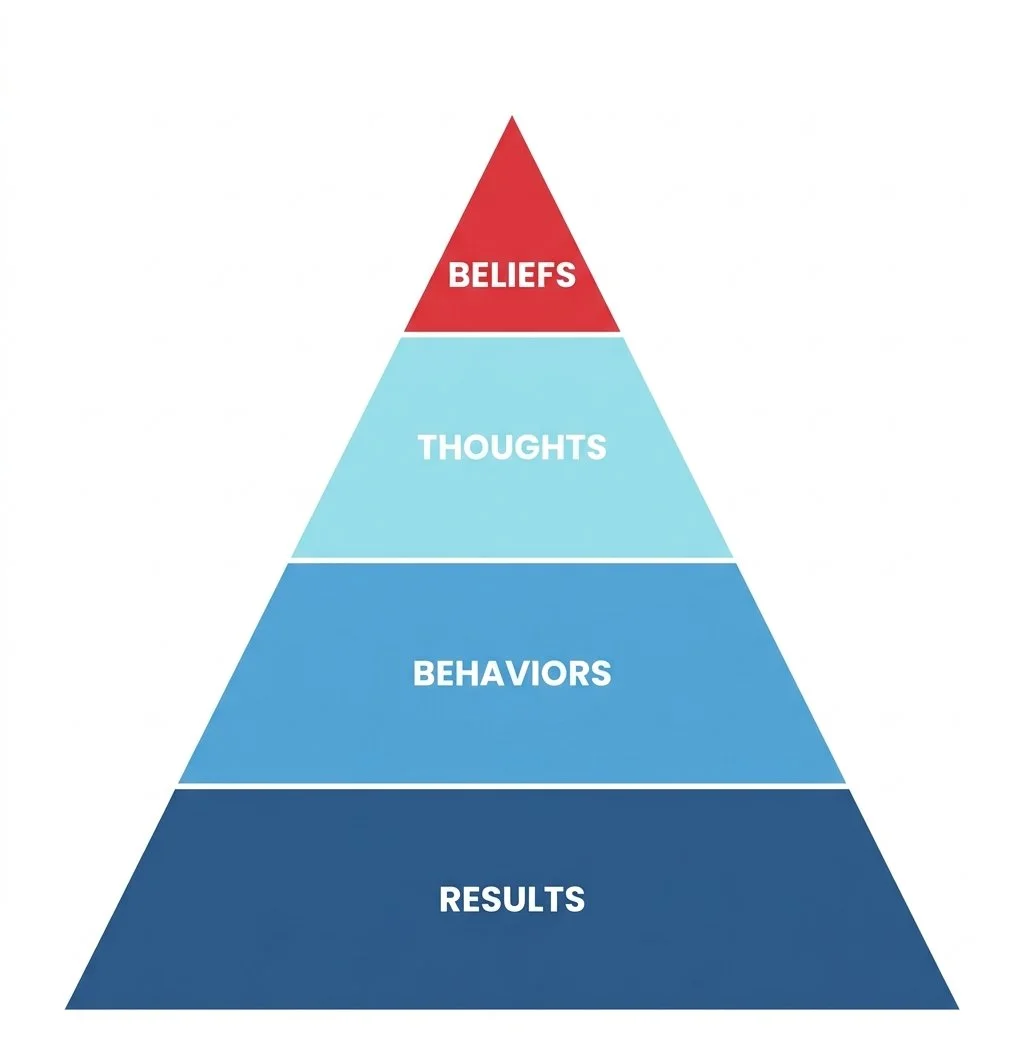
Behavior & Results Chart
Managers manage behaviors, not results. And we have to keep in mind that managers are just one foundational piece that dictates a person's results and behaviors. If we look at this pyramid from bottom to top: results are at the very bottom. Behaviors are what drive results, so behaviors sit right above it. If I want to lose 20 pounds, then I will diet and exercise. What drives our behaviors are our thoughts. If I think diet and exercise will lead to weight loss, then I will change my behaviors, which will then produce results. And at the very top of the pyramid are our beliefs. Beliefs are really tough to manage. If I don't believe I need to lose weight, then I simply won't lose weight, no matter what incentive program you put in front of me, no matter what pressure you apply. If I don't believe it, I won't do it.
It's important for managers to know that their job is to manage behaviors. Behaviors are the most direct path to results and they're the easiest to change. You can change behaviors in a matter of days, or at most a couple of weeks.
As you go up the pyramid — to thoughts and beliefs — those timelines get longer. It's hard to change thoughts. Thoughts take months. If someone doesn't think diet and exercise will lead to weight loss, it'll take repetitive, sustained convincing to change their thinking, which would then change their behaviors, which would then produce results. Beliefs are the hardest. It takes years. If a person doesn't believe they need to lose weight, it takes hundreds of conversations over many months — even years — to shift their belief system.
So as a manager: once you realize that behaviors aren't changing after a few weeks, go up to thoughts. That's when you have to think hard about the employee you're working with, because it's going to take significant effort, so much so that it will become a drain on your time and on the business. That's the point where you have to consider replacing that person. If you have a mid-level employee with a belief problem, that's a red flag. Promote them to your competition. You're better off moving on.
If you ever have an employee who says "That's not my job" or "That's not what I get paid to do around here" — that's a belief system problem, and it will take a long, long time to move them.
Keep it simple. We manage behaviors.
Give it a spin. Be Esteemed.
