
Productivity is a Rising Cost
This month's class in the Esteemed MBAi focuses on goal setting: establishing clear, smart goals with action plans that managers can follow up on with their directs in their weekly one-on-ones.
I won't get into the mechanics of how to properly build those goals — that's for the classroom. The takeaway I want you to leave with today is the importance of also focusing on productivity. Not just what's new. What's now.
We tend to think of goals as tools for learning something new — a new project, a new skill, a new initiative. And in doing so, we overlook a dire and urgent need: doing the things we're already doing, but doing them faster and more efficiently.
As managers and as organizations, we forget about the TPS report.
You know the one. Your direct makes it every single week. It takes an hour. It has taken an hour for as long as anyone can remember — and somewhere along the way, we all just decided that's as good as it's going to get.
It's not.
Making that TPS report faster and more efficient is mission-critical to the long-term health of your company. Here's why.
───
The Two Lines
Fifteen years ago, when I taught this class at companies like Gap Intelligence, I used a simple line chart.
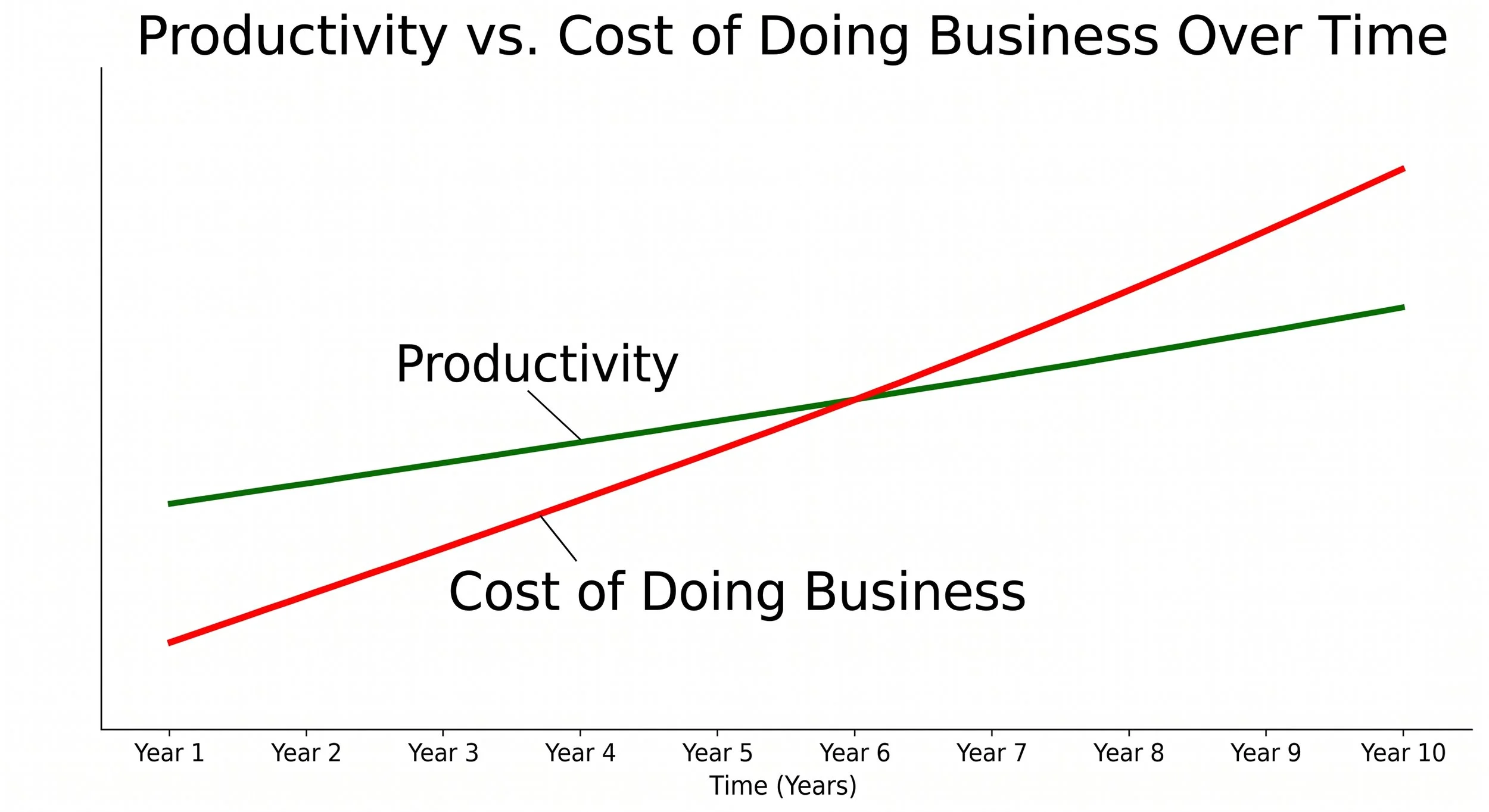
Picture an XY axis. There's a green line sloping gently upward — that's your productivity. Then there's a red line, also sloping gently upward — that's your cost of doing business. The fundamental requirement of a healthy company is simple: the green line must stay above the red line.
If your productivity is flat — if your company does the same things at the same rate, year after year — the cost of doing business will gradually overtake it. When the red line crosses the green line, you're on your way out of business.
Fifteen years ago, the cost of doing business increased roughly 3–5% annually. Rent, insurance, compensation, administrative overhead — it all crept up at a manageable rate. That meant your productivity had to improve by at least 3–5% per year just to stay ahead.
Since the pandemic, that number has changed dramatically.
The cost of doing business is now running at approximately 13.5% annually. An extraordinary increase across the board — rents, insurance, wages, everything. Which means your company needs to be at least 13% more productive this year than it was last year. And 13% more productive next year than it is this year.
That is a very high bar. And it doesn't come down.
───
What This Means for Your Goals
When you sit down with your directs to build their goals, don't only focus on what's new. Focus — especially — on what's existing.
That TPS report that took 50 minutes last year? It needs to take 43 minutes this year. And 38 minutes the year after. At some point in the next five years, it needs to take five minutes. Not because five minutes is an arbitrary target — but because if it still takes 50 minutes, the cost of producing it will eventually exceed its value to the business.
And here's the accelerant: with the rise of AI, your executive leadership team isn't waiting five years. They're expecting you to get there sooner. The tools exist. The expectation is set. The question is whether you're having the right conversations with your people.
So give it a spin. Sit down with your directs and talk through the tasks they do repeatedly — week after week after week. Ask them: how can we make this 15% more efficient this year? Maybe that means adopting a new tool. Maybe it means removing a step. Maybe it means rethinking the report altogether. The answer matters less than the question — because most people have never been asked it.
───
Goals are great. Learning new things is a wonderful use of your team's energy.
But don't forget what you're doing right now — and the urgent need to do it better.
Give it a spin. Be Esteemed.
